
A vacuum pump can be a source of mechanical vibration.
This is usually not a big problem for a simple vacuum system. But when the pump is connected directly to a chamber, instrument, or other vibration-sensitive equipment with rigid piping, some of that vibration can travel through the connection.
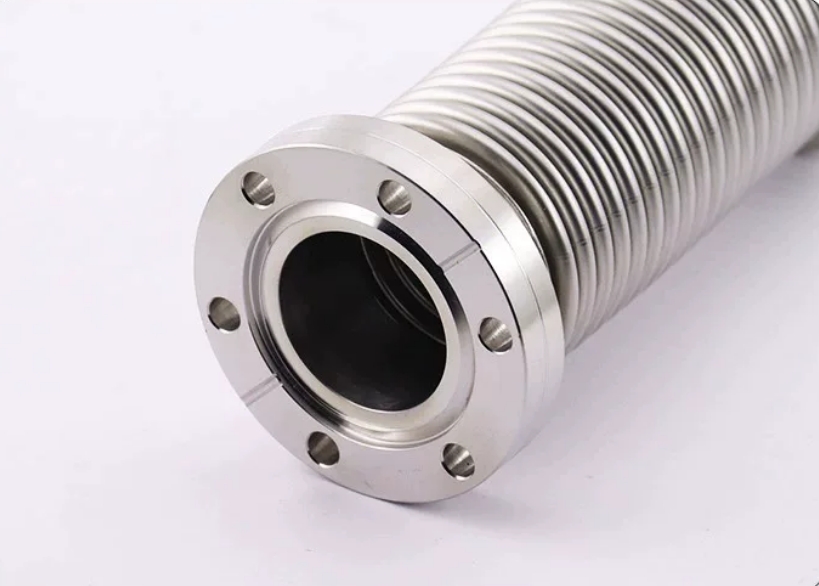
For some systems, this is something worth addressing.
One relatively simple solution is to put a flexible vacuum bellows between the pump and the rest of the system.
Why Does the Vibration Travel Through the Vacuum Line?
A rigid pipe does exactly what its name suggests. It holds the two ends together.
If the pump is vibrating, the pipe provides a mechanical path for that vibration to reach the chamber.
For example:
Vacuum Pump → Rigid Pipe → Vacuum Chamber
There is nothing in this connection that can absorb much relative movement between the two components.
The problem is not necessarily the pipe itself. It is simply a rigid connection between two pieces of equipment that do not behave exactly the same way when the system is running.
What Changes When a Bellows Is Used?
A metal bellows introduces some flexibility into the connection.
The arrangement becomes:
Vacuum Pump → CF Bellows → Vacuum Chamber
The bellows can accommodate a certain amount of movement while maintaining the vacuum connection.
This can help reduce direct mechanical vibration transfer and also deal with small movement caused by equipment operation or thermal changes.
The important point is that the bellows is not there to make the whole vacuum system flexible.
It creates a controlled flexible section where one is actually needed.
Where Should the Bellows Go?
In many pump connections, the bellows is installed close to the pump.
For example:
Vacuum Chamber → CF Bellows → Vacuum Pump
The exact arrangement depends on the equipment and the available space, but the basic idea is simple: the flexible section should be placed between components where relative movement or vibration needs to be managed.
The pump and chamber should still have their own mechanical supports.
The bellows should not be used to hold the weight of the pump.
What About Misalignment?
This is another reason bellows are useful.
In a real installation, the pump and chamber are not always perfectly aligned. There may be a small difference in position after installation, or the relative position may change slightly during operation.
A bellows can accommodate some of this movement.
But there is a limit.
It should not be used to connect two components that are obviously in the wrong position. If you have to force the bellows sideways, stretch it, twist it, or pull the flanges together with the bolts, the problem is probably the installation rather than the bellows.
Fix the alignment first.
Why Use a CF Bellows?
For UHV vacuum systems, the connection itself still has to meet the vacuum requirements of the system.
A CF bellows combines a flexible metal section with CF vacuum connections, making it suitable for systems where a flexible connection is needed without simply switching to a conventional flexible hose.
This is useful around equipment such as vacuum pumps, chambers, valves, and other components where some mechanical movement needs to be accommodated.
For higher-vacuum applications, leak performance also becomes important. Helium leak testing is commonly used to check the integrity of the bellows and its vacuum connections.
A Bellows Is Not Always the Answer
If vibration is coming from a pump, adding a bellows may help, but it does not fix every vibration problem.
The pump may need better mechanical isolation. The equipment may need additional support. The piping may be under stress. Or the vibration may simply be too large for a bellows to handle effectively.
So it is better to look at the whole connection rather than treating the bellows as a universal fix.
The useful question is:
Where is the mechanical vibration or movement coming from, and where should that movement be absorbed?
If the answer is the connection between the pump and the vacuum system, a flexible bellows can be a straightforward solution.
For different CF sizes, lengths, materials, and connection configurations, see our CF Vacuum Bellows product page.
CF High Vacuum Flexible Bellows | 304/316 Stainless Steel | CF Flange Custom