
A vacuum system may appear rigid once its chambers, valves, pumps, and piping have been connected with CF flanges. In practice, however, small movements can occur during installation, thermal cycling, equipment operation, or maintenance.
A rigid connection can transfer these movements directly to the connected components. In a high-vacuum or ultra-high-vacuum system, this can create unnecessary mechanical stress and make alignment more difficult.
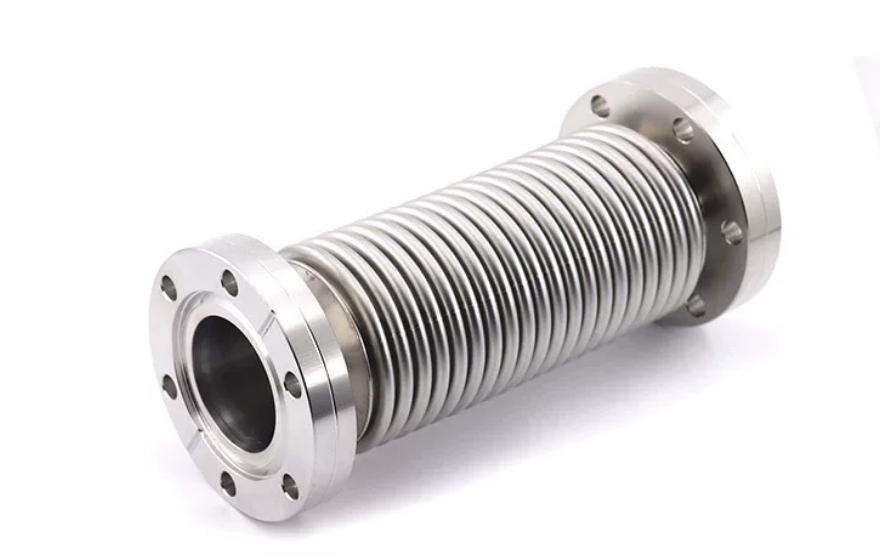
A CF vacuum bellows provides a flexible vacuum connection while maintaining a sealed vacuum boundary. It can be used to accommodate controlled movement, reduce vibration transmission, and simplify the connection between vacuum components.
For systems requiring non-standard dimensions, a custom CF bellows assembly can be manufactured according to the required flange configuration, length, and movement requirements.
1. Connecting Components That Cannot Stay Perfectly Rigid
Vacuum chambers and connected equipment are not always located in exactly the same position after installation.
Small differences can result from:
- Equipment positioning
- Assembly tolerances
- Thermal expansion
- Pump vibration
- Structural movement
- Maintenance and component replacement
A rigid tube may require very accurate alignment before installation. A flexible bellows can provide a degree of mechanical compliance between the connected components.
This is particularly useful when two CF-flanged components must be connected without placing excessive mechanical load on the surrounding vacuum equipment.
2. Absorbing Axial Movement
One common application of a vacuum bellows is accommodating axial movement.
For example, the distance between two connected components may change slightly as the equipment heats up or cools down. A rigid connection has little ability to accommodate this movement.
A bellows can deform axially within its designed operating range, allowing the connection to accommodate controlled movement without requiring the entire vacuum assembly to move.
The required bellows length and movement capacity should be selected according to the actual mechanical requirements of the system.
3. Reducing the Transfer of Mechanical Vibration
Vacuum pumps and other mechanical equipment can generate vibration.
If the pump is connected directly to a rigid vacuum line, part of this vibration can be transmitted through the piping or structural connection.
A flexible bellows can introduce mechanical compliance between the equipment and the vacuum system.
This does not mean that a bellows eliminates vibration by itself. Its effectiveness depends on the bellows geometry, length, installation condition, connected equipment, and the overall mechanical design.
For sensitive vacuum equipment, the bellows should therefore be selected as part of the complete vibration-control strategy.
4. Accommodating Small Alignment Differences
Perfect alignment between two vacuum components is not always practical.
A CF bellows can accommodate limited lateral or angular movement depending on its design and allowable operating range.
This can simplify the connection between:
- Vacuum chambers
- Pumps
- Valves
- Vacuum gauges
- Beamline components
- Experimental equipment
- Custom vacuum assemblies
However, the bellows should not be used to compensate for large installation errors. The connected components should still be properly aligned before installation.
5. Why Bellows Length Matters
Bellows length is not simply a dimensional choice.
The length of a bellows can affect its flexibility, available movement, installation space, and mechanical behavior.
A very short bellows may provide limited movement capability, while an unnecessarily long bellows may introduce more flexibility than the system requires.
The correct length should therefore be determined from the actual installation distance and required movement.
For custom applications, the overall length can be specified according to the equipment layout rather than being limited to a standard stock length.
6. The CF Flange Does Not Determine the Entire Bellows Assembly
A common mistake when specifying a vacuum bellows is to provide only the flange size.
For example, specifying:
CF100 vacuum bellows
does not completely define the required assembly.
The manufacturer may also need to know:
- Overall length
- Bellows inner and outer diameter
- Required movement
- Wall thickness
- End configuration
- Material
- Leak-rate requirement
- Operating vacuum
- Installation constraints
The CF flange defines the vacuum interface, while the bellows geometry determines much of its mechanical behavior.
7. Fixed-Length Bellows vs. Custom Bellows
Standard vacuum bellows are convenient when the system matches an available configuration.
A custom bellows becomes more useful when the installation requires a specific length or mechanical configuration.
| Standard Bellows | Custom CF Bellows |
|---|---|
| Standard lengths | Specified overall length |
| Standard flange combinations | Specified flange configuration |
| Limited dimensional choices | Custom bellows dimensions |
| Suitable for common installations | Suitable for equipment-specific layouts |
| Faster standard selection | Drawing-based configuration |
Custom manufacturing can be particularly useful for equipment integration, experimental systems, and vacuum assemblies where the available installation space is limited.
8. Choosing 304 or 316L Stainless Steel
CF vacuum bellows can be manufactured from stainless steel selected according to the application.
304 stainless steel can be suitable for general vacuum applications where standard stainless steel corrosion resistance is sufficient.
316L stainless steel may be preferred for applications requiring higher corrosion resistance or more demanding process environments.
Material selection should consider the complete system, including the vacuum environment, cleaning process, temperature, and any process gases or chemicals that may be present.
9. Helium Leak Testing Is an Important Acceptance Check
For high-vacuum and ultra-high-vacuum applications, the integrity of the bellows and welded connections is critical.
Helium leak testing provides a sensitive method for checking the integrity of the vacuum boundary.
A CF bellows assembly can therefore be specified with a required helium leak-rate limit according to the acceptance criteria of the vacuum system.
For applications requiring stringent leakage control, the test method and acceptance level should be defined before production rather than treated as an afterthought.
10. When Should You Consider a Custom CF Bellows?
A custom CF bellows may be worth considering when:
- The required installation length is not a standard size.
- Two CF components have limited alignment flexibility.
- Thermal movement needs to be accommodated.
- Mechanical vibration needs to be isolated from a sensitive component.
- The equipment layout requires a specific bellows diameter.
- Standard flange combinations do not match the vacuum system.
- The bellows must be manufactured according to an existing drawing or assembly.
In these situations, specifying the bellows according to the actual mechanical requirements is usually more useful than selecting a product based only on flange size.
How to Specify a Custom CF Vacuum Bellows
For a quotation, provide as much of the following information as possible:
- CF flange size and configuration
- Required overall length
- Bellows diameter
- Material
- Wall thickness if specified
- Required axial, lateral, or angular movement
- Operating vacuum range
- Required helium leak rate
- Installation limitations
- Drawing or existing sample
A drawing is particularly useful when the bellows is part of a larger vacuum assembly.
Custom CF Vacuum Bellows for UHV Applications
A CF bellows is more than a flexible section of vacuum piping. It is a mechanical component that must balance vacuum integrity with the required flexibility and movement.
For systems with specific installation dimensions or mechanical requirements, custom 304 or 316L stainless steel CF vacuum bellows can be manufactured according to drawings, specified dimensions, and vacuum-system requirements.
CF High Vacuum Flexible Bellows | 304/316 Stainless Steel | CF Flange Custom