Measure the required installed distance between the mating flange reference points. Do not assume that the nominal product length represents the final distance between the equipment components. State the measurement references used on the retrofit drawing and identify any compression or extension condition that is expected during installation.
The product page lists lengths of 200, 250, 300, 400, 500, 800, 1000, 1500 and 2000 mm, with a custom length option. A listed length may be a starting point, but the final selection should also consider the required movement, clearance and support arrangement. A custom length may be more suitable when a standard size leaves insufficient space or creates an undesirable installation condition.
Describe the movement the bellows must accommodate
Explain what movement the retrofit is expected to introduce or accommodate. This may include axial expansion or compression, limited lateral movement, angular movement, vibration or a small installation adjustment. The direction, expected amount and operating condition of each movement should be stated separately.
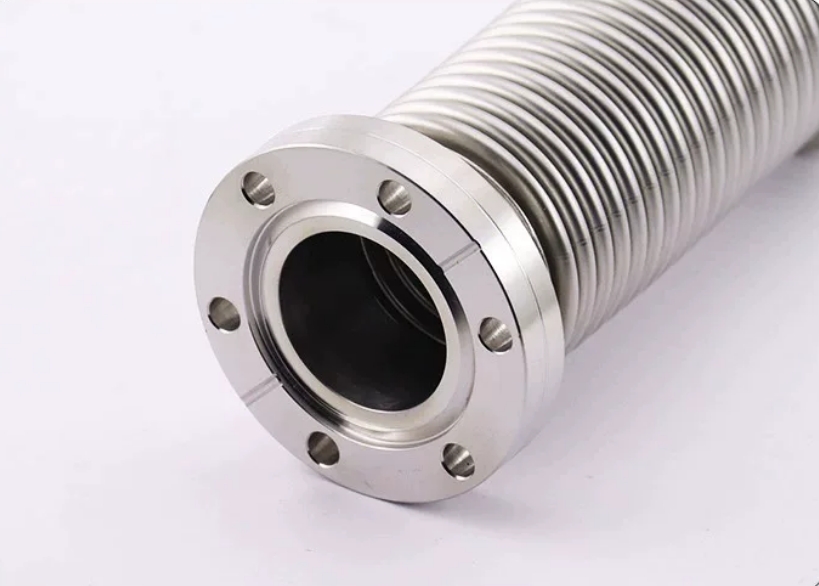
The CF bellows product page provides an axial expansion rate for the listed sizes, ranging from 14% to 23%. It also lists bending radius and bellows dimensions for each CF size. These figures should not be treated as a complete movement allowance for every retrofit. The allowable movement depends on the selected size, length, configuration and operating conditions, so the required movement must be reviewed for the specific assembly.
A bellows should not be specified to compensate for uncontrolled movement or a major offset between equipment. If the retrofit produces a large lateral or angular mismatch, a revised pipe route, support arrangement or additional component may be needed.
Check the bellows diameter and clearance
Space around the bellows is often reduced during equipment upgrades. Check the maximum allowable outer diameter, nearby brackets, thermal shields, cable routes, valves, access panels and other structures that may interfere with movement.
The listed product table provides bellows inner and outer diameters, wall thickness and bending radius for CF16 through CF250 configurations. Include the maximum available envelope in the quotation request so the proposed bellows can be reviewed against the retrofit space. A flange size that fits the vacuum port may still be unsuitable if the bellows body cannot move freely inside the equipment envelope.
Select 304 or 316L according to the vacuum environment
The product is available in 304 and 316L stainless steel. Material selection should be based on the vacuum environment, cleaning process, temperature conditions and any gases or chemicals that may contact the bellows. Review the material together with the surrounding vacuum components and the project documentation.
Do not select 316L or 304 solely from the flange size. State the required material in the enquiry and identify whether the same material requirement applies to the bellows, end connections and other wetted or exposed surfaces.
Specify helium leak testing and vacuum requirements
Leak performance should be defined before production. The product page lists 100% helium leak testing, a leak rate below 5 × 10⁻¹⁰ Pa·m3/s and a stated vacuum range from 1.5 × 10⁻⁵ Pa to 1 × 10⁻¹⁰ Pa. These figures provide a reference for the listed product configuration, but the retrofit requirements still need to be confirmed for the selected material, dimensions, flange arrangement and test conditions.
Include the required leak-rate acceptance level, test method, test documentation and vacuum operating range in the request. If the existing system uses a different acceptance criterion, provide that criterion instead of assuming that a catalogue value will automatically satisfy the retrofit.
Use a drawing to prevent retrofit errors
A dimensioned drawing is usually the most useful document for a custom CF bellows quotation. It should show:
- CF flange sizes and end configurations
- Installed length and measurement reference points
- Required inner diameter and maximum outer diameter
- Expected axial, lateral or angular movement
- Available clearance around the bellows
- Equipment supports and adjacent components
- Material and leak-testing requirements
If no drawing is available, provide photographs, measured dimensions and the original bellows information. A sample can help identify the existing geometry, but final dimensions and acceptance requirements should still be confirmed before production.
When a custom CF bellows is worth considering
A custom CF vacuum bellows is worth evaluating when the retrofit requires a non-standard installed length, a specific flange combination, restricted outer diameter, particular movement capability or a defined helium leak-test requirement. It can also be considered when a standard bellows cannot fit the revised equipment layout without being forced, twisted or mechanically loaded.
WeldPure lists CF vacuum bellows in 304 or 316L stainless steel, CF16 through CF250 sizes, standard lengths from 200 to 2000 mm and custom length options. Custom suitability remains subject to review of the retrofit drawing, movement requirements, operating conditions and vacuum acceptance criteria.
What to include in the quotation request
For a useful technical and commercial review, provide the retrofit drawing or measured layout together with the CF flange size, installed length, material, available clearance, bellows diameter requirements, expected movement, vacuum range, leak-rate requirement and documentation needs. Also state the quantity and whether the project is a one-time modification, a replacement requirement or a repeat OEM assembly.
To request a custom configuration for an ultra-high-vacuum equipment retrofit, see the CF High Vacuum Flexible Bellows product page and submit the drawing or dimensional information for review.