
Orbital welding is often selected for stainless steel tubing because it can provide consistent and repeatable welds.
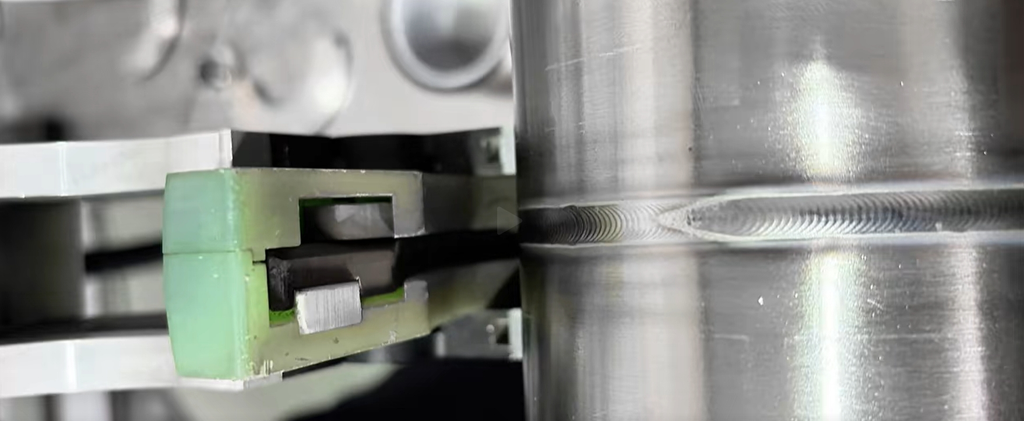
But when an orbital weld shows inconsistent weld width, an uneven internal root, incomplete penetration, or a visible difference at certain positions around the joint, the orbital welding program is not always the first thing to investigate.
The problem may have started during fit-up and tack welding.
Before an orbital welding head can complete a tube joint, the tube and fitting must first be correctly aligned and tack welded. These preparation steps determine the geometry that the orbital welding process has to work with.
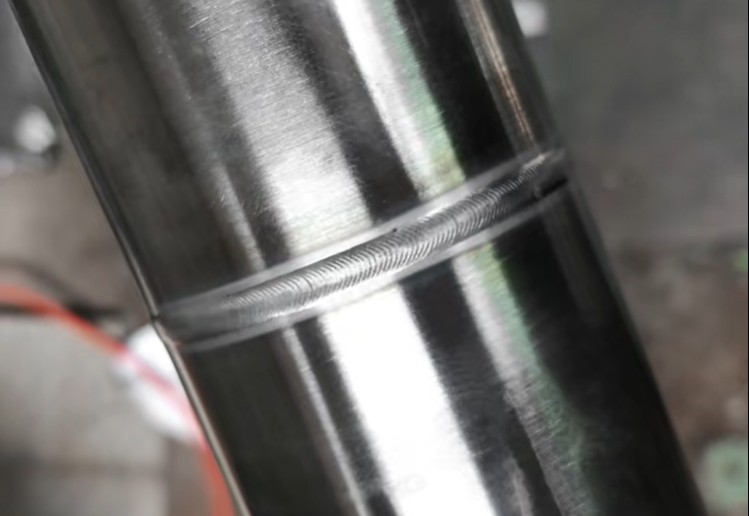
A small tack weld may seem insignificant, but it becomes part of the final weld.
For this reason:
Orbital welding quality starts with accurate fit-up and controlled tack welding.
1. Fit-Up Comes Before Tack Welding
Before making any tack weld, the tube and fitting need to be properly aligned.
For precision stainless steel tube assemblies, joint mismatch should be controlled as closely as practical. As a practical target for applications requiring tight dimensional control, the mismatch at the joint should be kept within approximately 0.1 mm.
Excessive mismatch can create several problems during and after orbital welding.
The most visible problem may be that the finished tube assembly is not smooth and even across the joint.
More importantly, a significant mismatch changes the geometry of the joint.
If the mismatch is concentrated on one side, one side of the joint may have a significantly different edge position from the other side. This can make consistent penetration more difficult and may increase the risk of incomplete penetration.
Therefore, fit-up should be checked before the joint is permanently fixed by tack welding.
What Happens When the Joint Is Misaligned?
A poorly aligned joint can result in:
- An uneven external weld profile
- An uneven internal root profile
- Local differences in joint gap
- Greater difficulty maintaining consistent penetration
- Increased risk of incomplete penetration
- A tube assembly that is not visually or dimensionally uniform
The orbital welding machine can control the welding process, but it cannot automatically correct a poorly aligned joint.
2. If Misalignment Cannot Be Completely Avoided
In real fabrication, perfectly eliminating every small amount of mismatch is not always possible.
When some mismatch remains, it should not simply be concentrated on one side of the joint.
Instead, where the joint design allows it, the mismatch should be distributed more evenly around the circumference.
For example, a joint with a small overall mismatch is generally easier to weld consistently when the difference is distributed around the joint rather than creating a pronounced step on one side.
This does not eliminate the dimensional deviation itself.
It reduces the risk of creating a significant local change in joint geometry.
A concentrated one-sided mismatch can create a much more difficult condition for the orbital weld than a small, more evenly distributed mismatch.
3. Tack Welding Fixes the Joint Geometry
Once the tube and fitting are correctly aligned, manual TIG tack welding is used to hold the joint in position.
This is where tack welding becomes an important part of the orbital welding process.
The tack weld is not simply a temporary connection.
After the orbital welding cycle begins, the arc passes over the tack and melts it together with the surrounding tube material.
Therefore:
Fit-up → Tack welding → Orbital welding
Each stage affects the next one.
If the fit-up is poor, the tack fixes the wrong geometry.
If the tack weld is too large, the orbital weld has to incorporate an unnecessarily large amount of additional weld metal.
If the tack is oxidized, the orbital weld begins with an already oxidized area.
4. An Oversized Tack May Not Be Fully Covered by the Orbital Weld
One of the most obvious problems caused by poor tack welding is a tack that is too large.
The normal orbital weld may have a relatively uniform width around the circumference.
However, if the manual tack is substantially wider than the orbital weld, the final weld may still show a wider area at the tack location.
The result can look like:
Uniform weld → wide tack location → uniform weld
The tack may remain visually distinguishable from the surrounding orbital weld.
This can make the final weld appear inconsistent even when the orbital welding parameters have remained unchanged throughout the cycle.
The objective of tack welding is therefore not to make the largest possible tack.
It is to make a small and controlled tack that securely holds the joint and can be incorporated into the final orbital weld.
5. Tack Welding Can Affect the Internal and External Weld Profile
A tack weld affects both sides of the tube joint.
If the tack has excessive heat input, penetration, width, or reinforcement, the orbital welding process encounters different conditions when it reaches that location.
This can result in differences between the tack location and the rest of the weld.
Externally, this may appear as:
- Local weld widening
- Uneven reinforcement
- A visible transition between the tack and orbital weld
Internally, it may appear as:
- Different root penetration
- Local root reinforcement
- An uneven internal weld profile
- A different surface condition at the tack location
For hygienic and high-purity stainless steel tubing, internal weld consistency is particularly important.
A weld that looks acceptable externally does not necessarily have a uniform internal root.
6. Poor Tack Welding Can Cause Internal Oxidation
Stainless steel needs adequate shielding from oxygen while the weld area is hot.
If the inside of the tube is exposed to oxygen during tack welding, oxidation can develop on the root side.
Depending on the welding conditions, the affected area may show yellow, brown, blue, or heavier oxidation.
This can become a problem even if the subsequent orbital welding operation uses proper internal argon shielding.
The reason is simple:
The oxidation was created before the orbital welding process began.
Orbital welding does not automatically remove the oxidation created during a previous tack weld.
For applications where internal surface condition is important, shielding during tack welding therefore needs to be considered as part of the overall welding process.
Note for Very Thin-Wall Tubing
For very thin-wall tubing, or when internal weld cleanliness requires additional control, internal argon shielding may be used when necessary during tack welding.
The requirement depends on the tube wall thickness, joint configuration, material, and application.
7. Tack Welding Can Affect Penetration
Tack welding and joint fit-up can influence the conditions required for consistent penetration during the final orbital weld.
A significant joint mismatch changes the effective edge geometry.
An oversized tack adds additional weld metal.
An uneven tack can also create a local change in the weld pool when the orbital arc passes over it.
These factors can make penetration less consistent around the joint.
In particular, a concentrated mismatch or poorly controlled tack can increase the risk of incomplete penetration.
This is why adjusting the orbital welding parameters should not always be the first response when penetration varies around a joint.
The condition of the joint before orbital welding should also be checked.
8. Practical Tack Welding Parameters
For thin-wall stainless steel tube assemblies, the tack weld should generally be short and controlled.
The following values can be used as practical starting points for certain applications:
| Tube Wall Thickness | Tack Welding Current | Tack Welding Time |
|---|---|---|
| 0.8–1.0 mm | 40 A | 0.15 s |
| 1.5 mm | 60 A | 0.20 s |
| 1.65 mm | 60 A | 0.20 s |
| 2.0 mm | 80 A | 0.20 s |
These values are practical starting points rather than universal welding specifications.
Actual settings may need to be adjusted according to:
- Stainless steel grade
- Tube diameter
- Wall thickness
- Joint geometry
- Fit-up condition
- Tungsten electrode
- Shielding conditions
- Torch configuration
- Welding equipment
The purpose is to create a tack that provides sufficient mechanical fixation without producing excessive weld metal or heat input.
9. The Tack Should Be Consistent Around the Joint
When several tack welds are used around a joint, consistency matters.
The tack welds should be reasonably consistent in:
- Size
- Welding time
- Current
- Location
- Penetration
- Overall profile
A single oversized tack can create a local condition that is different from the rest of the joint.
When the orbital welding head passes over that location, the weld pool responds to the different amount and shape of material.
This can create a visible or internal difference even though the orbital welding program has not changed.
The more consistent the pre-welded joint is, the easier it is for the orbital welding process to produce a consistent final weld.
10. Check the Joint After Tack Welding
The joint should be inspected again after tack welding and before the orbital welding cycle starts.
Useful checks include:
Fit-up
- Is the joint still aligned?
- Is the mismatch within the required tolerance?
- Has tack welding caused the tube or fitting to move?
Tack weld
- Are the tack welds small and consistent?
- Is any tack significantly larger than the others?
- Is there excessive penetration?
- Is there visible oxidation?
Orbital welding access
- Can the orbital head be installed correctly?
- Is there sufficient clearance?
- Can the planned welding sequence be completed?
This inspection can identify problems before they become part of the final weld.
11. Why Changing Orbital Welding Parameters May Not Fix the Problem
Suppose an orbital weld is normal around most of the circumference but becomes wider or different exactly where a tack weld was made.
It may be tempting to change:
- Welding current
- Travel speed
- Pulse settings
- Shielding gas flow
- Welding program
But if the problem occurs specifically at the tack location, the tack should be investigated first.
The sequence is:
Fit-up → Tack welding → Orbital welding → Final weld
A defect introduced during fit-up or tack welding may remain visible after the orbital welding process.
Changing the orbital parameters may alter the symptom without addressing the original cause.
This is why orbital welding troubleshooting should include the complete pre-welding process.
12. Good Orbital Welding Starts Before the Welding Head Starts
Orbital welding provides automation, but automation does not eliminate the importance of preparation.
A repeatable orbital weld requires a repeatable joint.
That means:
Accurate fit-up
→ Controlled mismatch
→ Proper tack welding
→ Stable joint geometry
→ Controlled orbital welding
→ Consistent final weld
Manual TIG tack welding is therefore not separate from orbital welding quality.
It is one of the steps that makes consistent orbital welding possible.
Conclusion
When an orbital weld has an uneven profile, local widening, inconsistent root penetration, or oxidation at specific positions, the cause may not be the orbital welding machine or its program.
The problem may have started during fit-up or tack welding.
Joint mismatch should be controlled before tack welding, with approximately 0.1 mm as a practical target where tight fit-up is required. If a small amount of mismatch cannot be completely eliminated, it should preferably be distributed rather than concentrated on one side.
The tack weld itself should then be small, controlled, and consistent.
An oversized tack may not be fully covered by the orbital weld. Excessive heat input or penetration can affect the internal and external weld profile. Poor shielding can cause internal oxidation, while poor fit-up can increase the risk of incomplete penetration.
For stainless steel tube assemblies, tack welding is not merely temporary positioning. It is part of the orbital welding process.
Good orbital welding starts with good fit-up and controlled tack welding.
Need Orbital Welding for Stainless Steel Tube Assemblies?
WeldPure provides orbital welding and stainless steel tube assembly fabrication with attention to fit-up, tack welding, internal argon shielding, weld consistency, and inspection.