
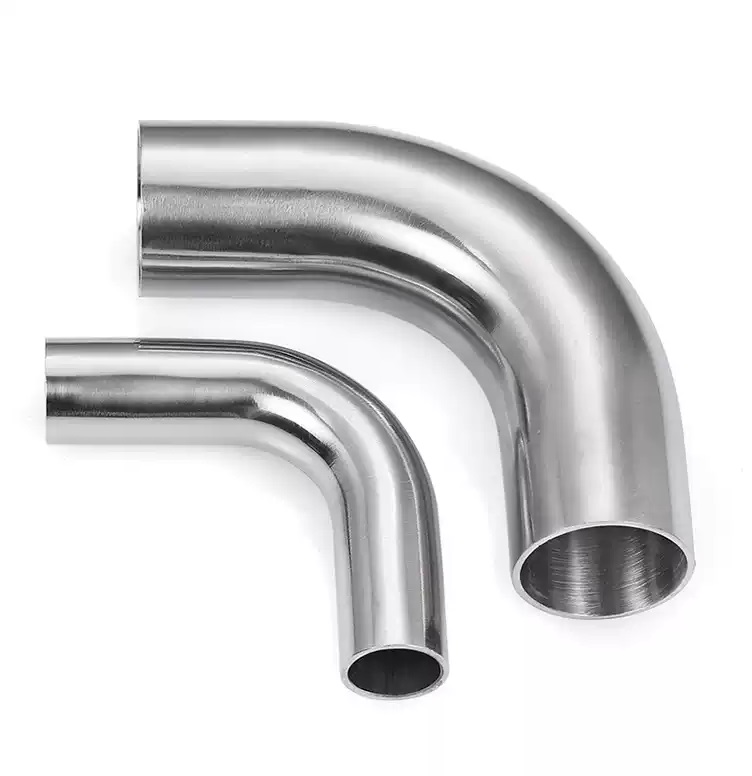
A sanitary 90° weld elbow is welded to your tubing at both ends, so the joint is permanent and any mismatch stays inside the line. If the elbow’s outside diameter (OD), wall thickness or weld ends do not match the tube, the result is an internal step, weld misalignment, or a rough area that traps product and is hard to clean. Sanitary tubing and fittings are sized by tube OD, and unlike general pipe the two are not interchangeable. Matching a weld elbow to your tubing comes down to three checks — OD, wall thickness and weld preparation — and this guide covers each, with reference to the 316L/304 stainless steel sanitary 90° long weld elbow supplied in tube ODs from 10 mm to 273 mm.
1. Match the Tube OD, Not the Nominal Pipe Size
Sanitary components are specified by the tube’s outside diameter. A nominal 1/2 in sanitary tube has a 12.7 mm OD and a nominal 1 in tube has a 25.4 mm OD. This is not the same as pipe: a nominal 1/2 in pipe is about 21.3 mm OD. Pipe and tube sizes are not interchangeable, so order by the actual OD your tubing uses.
A sanitary weld elbow is typically stocked across a wide OD range to suit both small and large lines. The 316L/304 sanitary 90° long weld elbow is available in tube ODs from 10 mm to 273 mm, covering common sizes such as 12.7 mm (1/2 in), 25 mm, 38 mm, 51 mm, 76 mm, 102 mm and 108 mm, and extending to 219 mm and 273 mm for larger process lines. Confirm that the elbow’s stated OD equals the tube OD you are welding to, and that the two are made to compatible OD tolerances; metric and imperial sanitary sizes are close but not always identical, so an “equivalent” label is not a guarantee of a flush fit.
2. Match Wall Thickness So the Bores Line Up
Wall thickness sets the inside diameter, which is the product-contact surface. At a butt weld, the elbow bore and the tube bore should meet without an internal step, so the elbow wall should be selected to match the tube wall, not just the OD.
The 316L/304 sanitary 90° long weld elbow is supplied in 1.5 mm, 1.65 mm, 2 mm or 3 mm wall thicknesses, plus custom values. Matching the elbow wall to the tube wall keeps the bores aligned and the transition smooth; where a tube uses a heavier wall for pressure or vacuum service, the elbow can be supplied in the same wall so the joint stays flush and drainable.
3. Prepare and Align the Weld Ends
The weld ends must be square cut, deburred and free of damage. During welding, alignment matters: common sanitary welding guidance (for example AWS D18.1/D18.2 for austenitic stainless tube) limits offset or misalignment to about 10% of wall thickness, and requires that welds contain no cracks, undercut, crevices, pits or protruding material. Two further points affect whether the joint is cleanable:
- Purge quality — residual oxygen in the backing purge causes heat tint, a discolored oxide that is less corrosion resistant and harder to clean. Good practice is to keep purge oxygen very low.
- Internal transition — the finished ID should be smooth and flush at the weld, with no ledge or crevice. A fitting with plain weld ends and a controlled ID finish helps achieve this.
4. Match the Internal Surface Finish
The elbow’s internal finish should be consistent with the adjacent tube and fittings. A common 3-A sanitary finish is around 32 Ra, while ASME BPE designations run from SF1 (about 20 Ra, mechanically polished) to SF4 (about 15 Ra, electropolished) on the product-contact surface. Joining a polished elbow to a rougher tube, or the reverse, can leave a localized finish change on the contact surface.
The 316L/304 sanitary 90° long weld elbow can be supplied with mechanically polished, mirror polished or electropolished internal surfaces, and with mill, satin, brushed or mirror polished external surfaces, so the ID and OD finish can be aligned with the rest of the line. Specify the finish in the same units (Ra) your tubing uses.
Specify These Options When Ordering a Sanitary 90° Weld Elbow
- Material — 304 or 316L stainless steel.
- Tube OD — the actual OD and tolerance, e.g. 10–273 mm range.
- Wall thickness — matched to the tube, e.g. 1.5, 1.65, 2 or 3 mm, or custom.
- Internal finish — polished, mirror polished or electropolished.
- External finish — mill, satin, brushed or mirror polished.
- Geometry — bend radius, straight (tangent) length and center-to-end dimension.
- End configuration — plain weld ends or custom.
- Documentation — such as a material test report, if your QA system calls for it.
How the 316L/304 Sanitary 90° Long Weld Elbow Covers These Points
The 316L/304 stainless steel sanitary 90° long weld elbow is offered in 304 or 316L, with tube ODs from 10 mm to 273 mm and wall thicknesses of 1.5 mm, 1.65 mm, 2 mm or 3 mm plus custom values, so the wall can be matched to the tube rather than forced to a single gauge. Both internal and external surfaces can be polished, and electropolishing is available depending on the requirement. Bend radius, straight length and center-to-end dimension can be customized for a specific layout, and extended straight sections are available where a tangent is needed — useful when the elbow also has to bridge a short spacing in the piping run.