
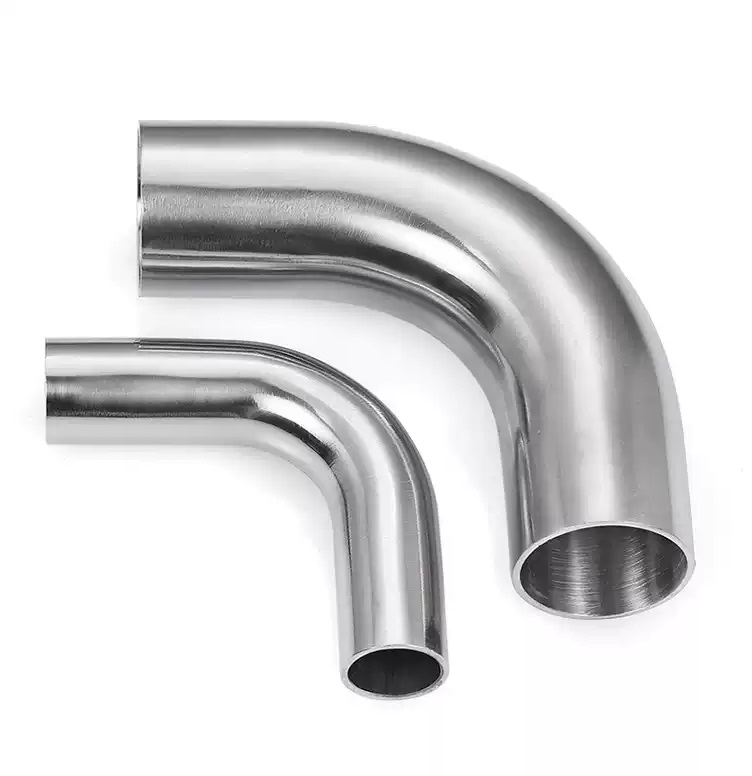
A sanitary 90° weld elbow with tangents is a standard elbow with an extra straight length added to one or both ends. That extra straight is the tangent (also called a straight leg). It looks like a small change, but it moves where the weld lands, changes how much the installer can trim, and can let the elbow span a short distance between two fixed points. This article explains what a tangent is, when it is worth specifying, when a plain elbow is the better choice, and what to put on the drawing. The 316L/304 stainless steel sanitary 90° long weld elbow can be supplied with custom straight lengths and center-to-end dimensions for exactly these cases.
What a Tangent Adds to a 90° Elbow
A plain weld elbow ends at the tangent points of the bend, so its overall size is fixed by the center-to-end dimension. A tangent elbow continues the tube centerline past those points with a straight section. The bend radius does not change; the added straight length is what increases the overall size and the center-to-end dimension.
Tangents can be added to both legs (symmetric) or to one leg only (asymmetric), depending on the layout. This is separate from the “long radius” or “short radius” choice, which sets the radius of the bend itself, not the straight length on the ends.
Why Specify a Tangent
1. Move the weld off the bend
Tangents put the weld joint clear of the radius. Welding on or right next to a bend is harder, because the surface curves both around and along the tube, which complicates fit-up and orbital welding. A straight leg gives the weld head a clean, round, straight section to clamp and rotate on, and keeps weld heat and distortion out of the bend. For orbital welding, the roundness and straightness of the weld land directly affect weld quality.
2. Leave a trim allowance for field fit-up
An extra straight length can be trimmed on site to hit the final dimension. That matters when a spool has to close a measured gap, or when dimensions are only confirmed after the surrounding equipment is set. Without a tangent, a wrong length means re-cutting or re-ordering the fitting.
3. Provide a straight seat for a clamp, flange or instrument
The straight section can accept a hygienic clamp ferrule, a flange, or a weld-in instrument connection on a straight run rather than on the curve. Mounting onto straight tube is simpler and produces a cleaner joint.
4. Bridge a short gap between two fixed points
When the distance between two connections is shorter than a plain elbow plus a tube spool, a tangent elbow can span it directly. This can reduce the number of welds and simplify a tight assembly.
5. Match an existing or repaired layout
When replacing a fitting in an installed line, a tangent lets you match the existing center-to-end dimension without adding an extra piece of tube.
When a Plain Elbow Is Enough
- The layout already has enough straight tube for welding and trimming.
- Space is tight and the overall length must stay minimal.
- You want the fewest welds and the simplest, lowest-cost fitting.
In these cases a standard elbow without tangents is the practical choice.
How to Specify a Tangent Elbow
- State which ends carry the tangent — one leg or both.
- Give the tangent length, or the resulting center-to-end / overall length.
- Keep the bend radius and angle (90° standard, custom available).
- Specify material (304 or 316L), wall thickness and surface finish.
- Note whether the tangent is a minimum or an exact dimension.
- Attach a drawing showing the radius, tangent and center-to-end.
How the 316L/304 Sanitary 90° Long Weld Elbow Covers These Cases
The is offered in 304 or 316L with tube ODs from 10 mm to 273 mm, wall thicknesses of 1.5 mm, 1.65 mm, 2 mm or 3 mm plus custom values, and internal or external polishing. Straight length and center-to-end dimension can be customized, and an extended straight section can be added where a tangent is required; bend radius and angle can also be customized for a specific layout.