
Most hygienic lines are built from 45° and 90° elbows, but a real layout does not always land on a standard angle. When a run has to meet an existing nozzle, clear an obstruction, or follow an as-built route, a 90° elbow either overshoots or under-turns. A custom-angle sanitary weld elbow solves this, but the angle changes the fitting’s geometry, so ordering one takes a few more dimensions than a standard part. The 316L/304 stainless steel sanitary 90° long weld elbow is supplied with a 90° standard bend and custom angles, radii and center-to-end dimensions.
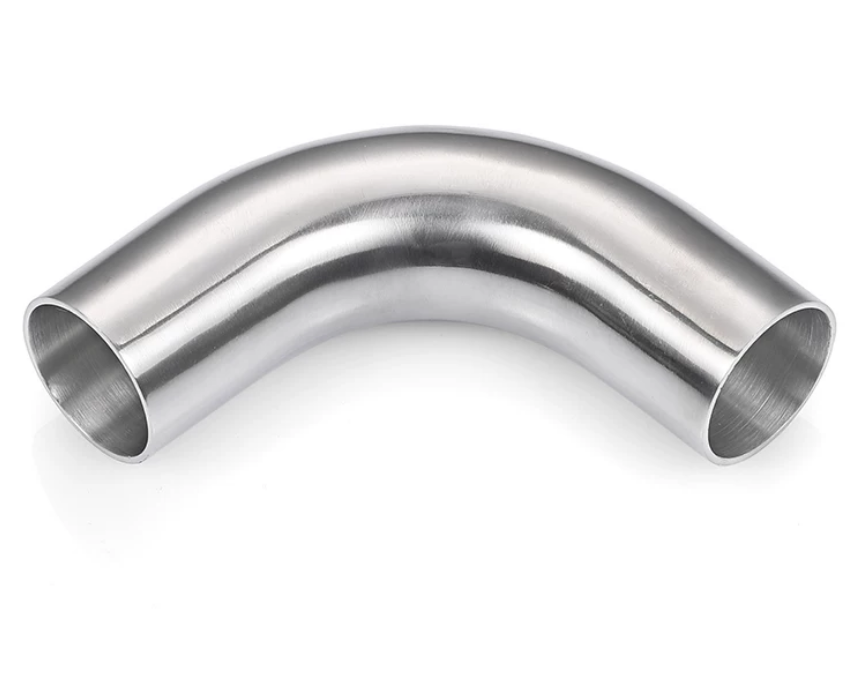
When You Need a Non-Standard Angle
- Connecting to existing or legacy equipment at a fixed, unusual angle.
- Routing around an obstruction without adding extra fittings.
- Making a gentle offset — for example two 45° elbows in place of a single 90°.
- Following an as-built route where the angle was set on site.
- Meeting a slope or drainability requirement that a 90° turn cannot satisfy.
Standard Angles vs Truly Custom Bends
The common sanitary angles are 45° and 90°, and 180° return bends are also standard. Some ranges add near-90° variants such as 88° and 92° for specific fit-up and springback situations. Angles such as 60°, 30°, or any value set by a drawing are custom, and not every supplier can produce them. Confirm that the supplier can make the exact angle you need, not just the nearest standard one.
The Geometry That Changes With the Angle
The bend radius does not change with the angle, but the center-to-end dimension does. For an elbow with a centerline radius R bent through angle θ, the center-to-end dimension follows:
Center-to-end = R × tan(θ / 2)
For a 90° elbow, tan 45° = 1, so the center-to-end equals the radius. For a 45° elbow of the same radius, tan 22.5° ≈ 0.414, so the center-to-end is only about 41% of the radius. This is why a 45° elbow is much shorter than a 90° elbow of the same radius — and why the angle should always be given together with the radius when you specify a custom bend.
Two 45° elbows do not equal one 90° in length: they form a rolling offset that needs a straight section between them, so the overall length depends on that spacing, not only on the two bends.
What to Put on the Order or Drawing
- Angle — in degrees, e.g. 60° (90° standard, custom available).
- Bend radius — the centerline radius, since it sets the center-to-end together with the angle.
- Center-to-end or overall length — the dimension that must fit the layout.
- Leg orientation — which leg, and any tangent or straight length.
- Tube OD and wall thickness — matched to the tube (e.g. 10–273 mm OD; 1.5 / 1.65 / 2 / 3 mm wall or custom).
- Material — 304 or 316L.
- Surface finish — internal and external (polished, mirror or electropolished).
- End configuration — plain weld ends or custom.
Because a custom angle is made to your dimensions, a simple sketch showing the angle, radius and center-to-end is usually enough to quote.