Sanitary 90° weld elbows are available in a range of standard sizes, but availability varies by manufacturer, tube standard, material and surface finish. When a piping project requires larger diameters, such as 152.4 mm, 219.1 mm or 273.05 mm OD, it is important to confirm whether an existing catalogue product meets the installation requirements or whether a custom-made fitting is more appropriate.
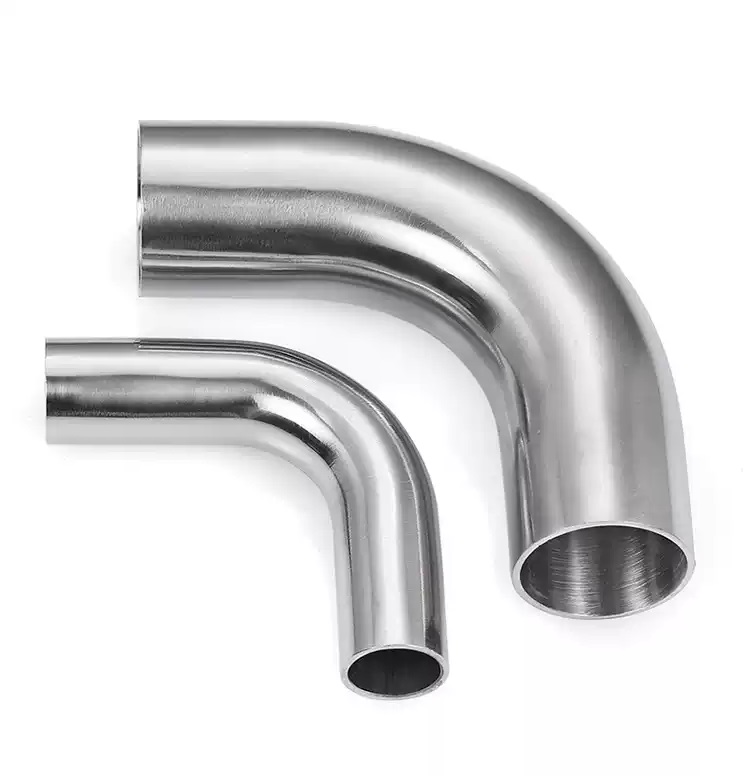
Large-diameter sanitary elbows may be used in process transfer lines, CIP systems, utility distribution, tank connections and skid interconnections. In these applications, dimensional compatibility, internal surface quality and fabrication requirements all influence product selection.
This article outlines the main considerations when sourcing large-diameter sanitary 90° weld elbows and explains what information to provide when requesting a quotation.
1. Standard Sizes and Product Availability
Sanitary fitting manufacturers offer different size ranges depending on their production capabilities, target markets and applicable dimensional standards. Some suppliers provide large-diameter elbows as standard products, while others manufacture specific dimensions to order.
Even when an elbow is available in a catalogue, its dimensions and finish may not match the requirements of an existing piping system. For example, the required tube outside diameter, wall thickness, bend radius or center-to-end dimension may differ from the listed configuration.
For this reason, product selection should be based on the actual piping specification rather than nominal size alone.
When a suitable catalogue configuration is unavailable, a made-to-order fitting may be considered. The manufacturer can review the required dimensions, fabrication method and finishing requirements before confirming feasibility.
2. Confirm the Tube Standard and Outside Diameter
Dimensional compatibility is one of the first considerations when selecting a replacement elbow or specifying a new piping assembly.
Different tube and fitting standards may use different outside diameters, even when their nominal size designations appear similar. For example, 1.5-inch tubing in a common inch-based sanitary system has an outside diameter of 38.1 mm, whereas a metric tube series may use a different diameter.
Larger dimensions also require careful identification. An outside diameter of 152.4 mm is commonly associated with 6-inch tubing, while 219.1 mm and 273.05 mm are common dimensions in industrial pipe systems. These dimensions alone do not establish compliance with a particular sanitary fitting standard.
Before ordering, confirm:
- Actual tube outside diameter (OD)
- Applicable tube and fitting standard
- Existing connection dimensions
- Wall thickness and internal diameter
- Any dimensional requirements specified in the project drawing
A calliper can help verify accessible tube dimensions, but the governing drawing or tubing specification should be used where available.
The objective is to ensure that the elbow matches the existing tubing and provides a suitable transition at the welded connection.
3. Wall Thickness and Internal Diameter
Wall thickness affects the internal diameter, joint preparation and mechanical performance of the finished assembly.
Two elbows with the same outside diameter may have different internal diameters if their wall thicknesses differ. This can create an internal step at the joint, which may be undesirable in hygienic process piping.
Wall thickness should therefore be specified independently of outside diameter. The appropriate value depends on the existing tubing, design conditions, applicable specifications and fabrication requirements.
When replacing an existing fitting, confirm the tube wall thickness rather than assuming that all large-diameter sanitary elbows use the same wall dimension.
If the elbow is part of a pressure-containing system, its suitability should also be evaluated against the applicable design requirements.
4. Bend Radius, Center-to-End Dimensions and Straight Tangents
The bend radius and overall dimensions determine how an elbow fits into the piping layout.
Commonly specified dimensions include:
- Bend radius: The radius of the elbow’s centerline through the bend.
- Center-to-end dimension: The distance from the bend centerline to the end of the fitting, as defined by the relevant drawing or standard.
- Straight tangent length: The straight section provided at one or both ends of the bend.
These dimensions influence installation space, weld access and alignment with adjoining components.
For replacement work, the existing fitting dimensions or approved piping drawing should be checked before selecting a standard elbow. Where a specific center-to-end dimension or tangent length is required, the manufacturer should confirm how it relates to the proposed bend radius and overall geometry.
A dimensioned drawing is particularly useful when the elbow must fit into an existing assembly with limited installation space.
5. Formed and Segmented Elbow Construction
Depending on the diameter, geometry, material and manufacturing process, an elbow may be produced using a forming process or fabricated from multiple sections.
The appropriate construction method depends on the required dimensions, production capabilities and acceptance criteria.
When a segmented construction is proposed, additional considerations include:
- Number and location of internal welds
- Internal weld finishing and surface continuity
- External finishing requirements
- Inspection methods and acceptance criteria
- Suitability for the intended process and cleaning procedures
For hygienic applications, internal weld treatment is particularly important because surface irregularities and poorly finished joints may affect cleanability.
The proposed construction method should be reviewed against the project specification before production begins. Internal grinding or polishing alone does not establish compliance with every hygienic or surface-quality requirement.
6. Internal and External Surface Finish
Surface finish requirements should be defined according to the intended application rather than described only as “polished.”
Several finishing terms may appear in sanitary fitting specifications:
- Mechanical polishing: A finishing process used to improve surface appearance and texture.
- Mirror polishing: A general description of a highly reflective surface; the term alone does not specify a measurable roughness value.
- Electropolishing: An electrochemical finishing process that removes material from the surface under controlled conditions.
- Ra requirement: A numerical surface roughness parameter that can be specified for internal and external surfaces separately.
When a project specifies a maximum Ra value, confirm the required measurement method, measurement location and reporting requirements.
For critical hygienic systems, the internal surface may have different acceptance criteria from the external surface. These requirements should be stated in the enquiry so that the proposed finishing process can be evaluated accordingly.
If inspection records or surface roughness reports are required, include them in the quotation request.
7. Information to Include in a Quotation Request
Providing a complete specification helps the manufacturer assess feasibility and reduces the need for repeated clarification.
For a large-diameter sanitary 90° weld elbow, the enquiry should include the following information wherever applicable:
| Item | Information to provide |
|---|---|
| Outside diameter | Actual tube OD in millimetres or inches |
| Dimensional standard | Applicable tube and fitting standard |
| Material | 304, 316L or another specified grade |
| Wall thickness | Required tube or fitting wall thickness |
| Bend angle | 90° or another specified angle |
| Bend radius | Required centerline radius or drawing reference |
| Center-to-end | Required overall geometry |
| Straight tangent | Required straight length at each end |
| Surface finish | Internal and external requirements, including Ra where applicable |
| Construction | Any restrictions on forming or segmented fabrication |
| Inspection | Required dimensional, visual or surface inspection records |
| Quantity | Prototype, one-off requirement or production quantity |
A dimensioned drawing is the preferred reference when several dimensions must be matched simultaneously. If a drawing is unavailable, photographs and measured dimensions can help establish the initial requirements, subject to further technical confirmation.
8. Custom Large-Diameter Sanitary Elbows from WeldPure
WeldPure offers 304 and 316L stainless steel sanitary 90° long weld elbows, with listed outside diameter options extending to 273 mm. The published size options include 108, 114, 129, 133, 140, 159, 168, 219 and 273 mm.
For projects requiring dimensions beyond a standard catalogue configuration, enquiries can include custom wall thickness, bend radius, straight tangent length and center-to-end dimensions, subject to manufacturing review.
Internal and external finishing options, including mirror polishing and electropolishing, can also be discussed according to the application and specified acceptance criteria.
To assess compatibility with an existing piping system, provide the tube OD, wall thickness, applicable dimensional standard, material grade and surface finish requirements. A drawing is helpful when the elbow must match an existing assembly.
Visit the 316L/304 Stainless Steel Sanitary 90° Long Weld Elbow product page to submit your dimensions and request a quotation.
Frequently Asked Questions
Are large-diameter sanitary 90° elbows available as standard products?
Availability depends on the manufacturer, dimensional standard, material and finish requirements. Some suppliers offer larger sizes as standard products, while other combinations may require a custom quotation.
Can a sanitary elbow be manufactured to a specified bend radius?
A custom bend radius may be possible depending on the diameter, wall thickness, material and manufacturing method. Confirm the required radius and overall dimensions with the manufacturer before ordering.
Can an elbow be supplied with a specific internal surface roughness?
A specified internal Ra requirement can be included in the enquiry. The manufacturer should confirm the available finishing process, measurement method and inspection documentation.
What information is most important when replacing an existing elbow?
Start with the actual tube OD, wall thickness, dimensional standard, bend radius and center-to-end dimensions. Material grade and internal surface finish should also be confirmed.
Should a drawing be provided when requesting a custom elbow?
A dimensioned drawing is recommended, especially when the elbow must fit an existing piping layout. It helps clarify the geometry, connection dimensions and finishing requirements before production.